Cinema screens are designed to deliver consistent visual performance for many years. Once installed, they become part of the theatre’s architecture and are rarely reconsidered unless visible damage appears. If the surface looks intact, it is generally assumed that performance remains unchanged.
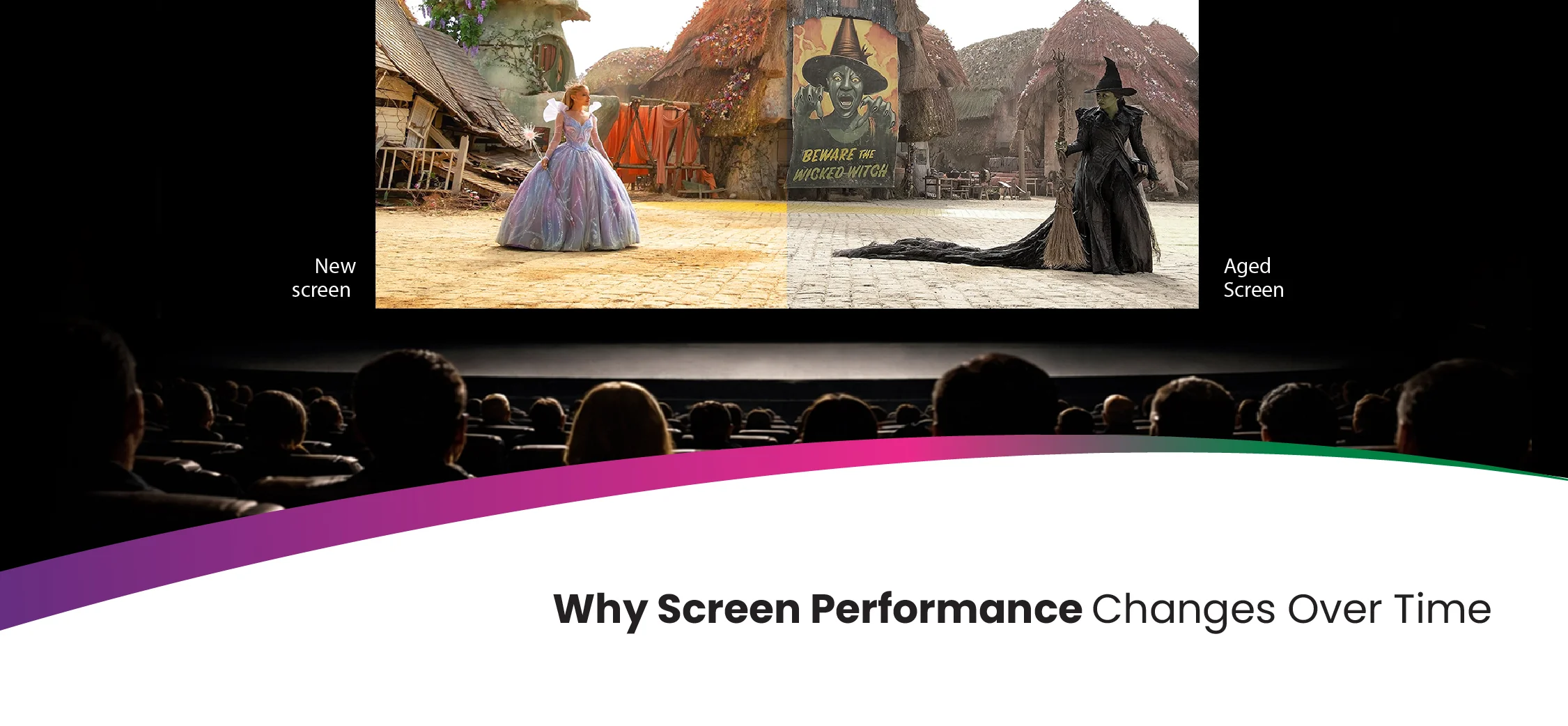
In practice, cinema screen performance evolves gradually over time. This evolution is not necessarily a result of poor maintenance or misuse. It is a natural outcome of continuous operation under normal projection and environmental conditions.
The Screen as an Optical Component
A cinema screen is not simply a white surface. It is a precision optical system engineered to reflect projected light in a controlled and predictable manner. Its gain, diffusion properties, coating structure and surface uniformity are carefully designed to ensure accurate brightness levels, consistent contrast and balanced image distribution across the auditorium.
Every projection introduces high-intensity light energy onto the surface. Over thousands of operating hours, this continuous exposure interacts with the screen’s reflective layers. While the changes are subtle, they are cumulative.
Just as projectors experience lamp aging or laser output variation, screen materials also undergo gradual optical shifts. The difference is that these shifts tend to be less visible in the short term, making them harder to detect without deliberate evaluation.
Environmental Influence Over Time
Cinema auditoriums are controlled environments, but they are not static. Temperature cycles, airflow patterns and microscopic airborne particles are present even in well-maintained spaces. Over long durations, these factors interact with the screen surface.
Heat generated by projection systems and audience occupancy contributes to repeated thermal cycles. Air circulation systems maintain comfort but also create consistent airflow patterns across the screen. Even minute particulate presence can influence surface characteristics over extended periods.
None of these factors cause immediate degradation. Instead, they contribute to incremental optical variation. The screen continues to function, but its reflective behaviour may no longer be identical to its original calibrated state.
The Nature of Gradual Change
Performance shifts rarely occur abruptly.
Brightness does not decline overnight.
Uniformity does not fail in a single month.
Contrast does not disappear in one season.
Instead, micro-level changes accumulate slowly. A slight variation in reflectivity in one region. A marginal shift in diffusion behaviour. A small reduction in peak brightness response. Each variation may be negligible on its own, but together they can subtly influence perceived image depth and clarity.
Because these changes are progressive, human perception adapts. Operators become accustomed to the evolving image quality. Audiences interpret the presentation as standard. The new output becomes the accepted baseline, even if it differs from the screen’s original performance.
Why It Often Goes Unnoticed
The absence of visible damage creates an assumption of stability. Tears, stains or structural defects are obvious indicators of concern. Optical drift is not.
Unlike projector calibration errors, which may present as noticeable color imbalance or brightness inconsistency, screen performance changes are typically more nuanced. They affect how light is reflected rather than how it is generated. As a result, the presentation may still appear “good,” but not necessarily optimal.
Without periodic performance benchmarking, gradual deviation can continue for years before being addressed. By that point, the difference between original and current output may be significant enough to impact audience perception, especially in premium large-format environments.
The Business Impact of Optical Drift
Cinema presentation quality directly influences audience experience. Brightness consistency, contrast depth and uniform illumination contribute to immersion. When these elements subtly decline, the change may not be consciously identified, but it can influence perceived sharpness and visual impact.
In competitive exhibition markets, maintaining reference-level performance is increasingly important. Premium projection technologies such as laser systems and advanced HDR formats demand surfaces capable of sustaining stable reflectivity and diffusion properties over long periods.
If the screen surface evolves without evaluation, the overall system performance may no longer align with the intended projection standards.
Treating the Screen as a Working Asset
Projectors are monitored. Audio systems are calibrated. Seating and acoustics are periodically upgraded. The cinema screen deserves similar consideration.
Recognising that a screen is a working optical component rather than a permanent fixture enables proactive performance management. Periodic inspection, measurement and benchmarking against installation specifications help ensure that the visual experience remains consistent with design intent.
This approach shifts the conversation from reactive replacement to informed lifecycle planning.
Engineering for Long-Term Stability
At Galalite Screens, we approach cinema screen manufacturing with long-term optical stability as a core objective. Our surfaces are engineered using advanced coating technologies and precision manufacturing processes to maintain controlled reflectivity, diffusion balance and structural integrity across extended operating hours. Decades of innovation in cinema screen development enable us to design products that perform consistently in diverse global environments while supporting modern projection technologies. Because in cinema, sustained image excellence is not assumed. It is engineered, measured and maintained.