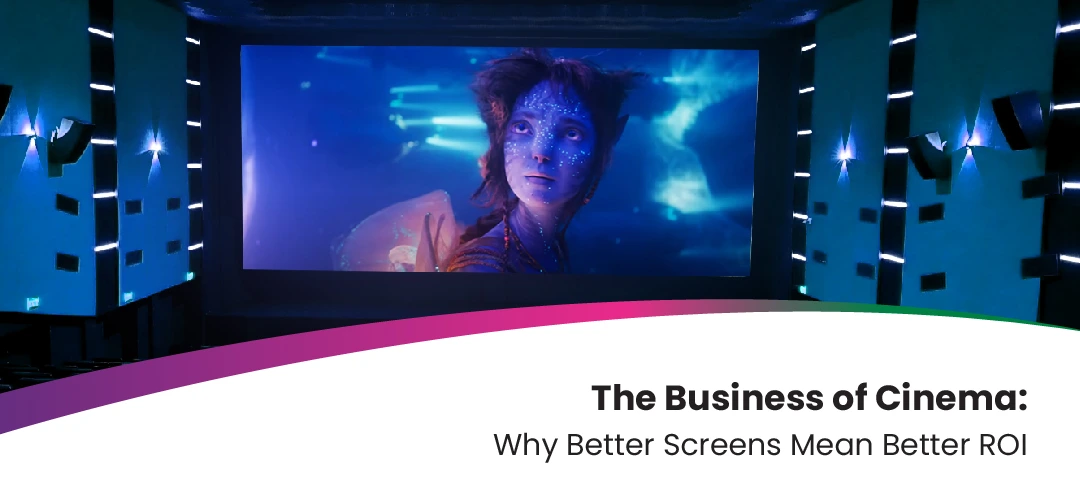

Cinema projection screens are the final and most visible component in any cinema projection chain. Yet they are often the least understood. A screen is not a passive surface; it is an engineered optical system designed to reflect, control, and deliver a specific quality of light to every seat in the auditorium.
In this guide, we break down exactly how cinema projection screens work, what separates a high-performance commercial screen from a basic surface, and why the screen you choose can make or break your audience’s viewing experience.
1. The Basic Principle – Reflection, Not Emission
Unlike a television or LED wall, a projection screen does not produce light. It reflects light projected onto it from a projector. The quality of that reflection — its brightness, uniformity, colour accuracy, and angular spread — depends entirely on the screen’s surface material and construction.
The projection chain works as follows:
- The projector generates an image using a light source (xenon lamp, laser, or RGB laser).
- The light travels through optical components and is thrown onto the screen.
- The screen surface reflects the light toward the audience.
- The audience perceives the reflected image as the movie.
Every weakness in the screen surface – uneven coating, incorrect gain, poor angular properties degrades the image the audience sees, regardless of how good the projector is.
2. Screen Surface Materials
Commercial cinema screens are manufactured using specialised surface coatings applied to a woven or perforated base fabric. The three primary surface types used in modern commercial cinemas are:
Matte White
Matte White surfaces reflect light evenly in all directions (Lambertian reflection). They offer a gain of approximately 1.0 and wide viewing angles, making them suitable for standard 2D digital projection in medium-sized auditoriums. Galalite’s Matte White screen is engineered for uniform luminance and reliable colour accuracy.
High-Gain Coated Silver Surfaces
Silver-coated screens use a metallic reflective layer to focus reflected light within a narrower viewing cone. This increases brightness (gain above 1.0) for audiences seated in the central zone and is essential for passive 3D systems, which lose significant brightness through polarised glasses. Galalite’s Prism 3D is a purpose-built high-gain 3D screen.
Lensray-Enhanced Surfaces (Galalite Proprietary)
Galalite’s proprietary Lensray Technology uses a micro-lenslet array embedded in the screen coating to precisely control how light is redirected to the audience. Unlike standard reflective coatings, Lensray enables higher brightness, wider viewing angles, and superior uniformity simultaneously — benefits that traditionally required trade-offs.
3. Screen Gain Explained
Screen gain is the ratio of light reflected by a screen compared to a perfect matte white reference surface. A gain of 1.0 means the screen reflects the same amount as the reference.A gain of 2.4 means it reflects 2.4 times as much light in the primary viewing axis.
Key Insight — Gain vs Viewing Angle
Higher gain always narrows the effective viewing angle. A gain-3.0 screen delivers exceptional brightness to central seats but may produce hotspotting or dim edges in wide auditoriums. Correct screen selection requires matching gain to auditorium geometry.
Galalite’s Cumulative Gain technology addresses this challenge by engineering screens that deliver elevated effective gain across a wider cone of angles, reducing the traditional trade-off.
4. Perforation and Audio Pass-Through
Most commercial cinema screens are perforated — they contain thousands of small holes that allow sound to pass from speakers positioned behind the screen. Perforation patterns are engineered to minimise their visibility to the audience while maintaining acoustic transparency. Speaker placement behind the screen ensures dialogue and effects appear to originate from the on-screen action.
5. Screen Size and Throw Distance
Screen size is selected based on the auditorium’s seating geometry, with the goal of ensuring every viewer has a minimum viewing angle of 28 degrees from screen bottom to screen top (per SMPTE recommendations). Throw distance — the distance from projector to screen — determines the projector brightness required and must align with the screen’s gain and size.
| Screen Type | Typical Gain Range | Best For |
|---|---|---|
| Matte White | 0.9 – 1.1 | 2D digital projection, wide auditoriums |
| High-Gain Silver – Lensray – Enhanced | 2.0 – 3.4 | Passive 3D, PLF, bright environments |
| RGB Laser (Mirage XDL) – Lensray – Enhanced | Custom engineered | RGB laser, HDR, premium cinemas |
6. Why the Screen Is the Most Important Part of the Projection Chain
A DCI-compliant projector will cost tens of thousands of dollars. An inadequate screen wastes that investment. The screen determines the maximum achievable brightness, colour accuracy, uniformity across the auditorium, and 3D performance. It is the last component the light touches before the audience’s eye.
Galalite has been engineering cinema screens since 1959, with installations in over 50 countries and innovations including the world’s first RGB laser projection screen (Mirage XDL). Each product is designed with a specific projection environment in mind — ensuring cinema owners match the right screen to their system.
Frequently Asked Questions
Conclusion
Cinema projection screens are precision optical instruments. Understanding how they work — from surface coatings and gain ratios to perforation and throw geometry — enables better purchasing decisions and better audience experiences. Galalite Screens combines over 60 years of manufacturing expertise with proprietary technologies like Lensray to deliver screens engineered for every projection environment.
Ready to choose the right screen?
Contact Galalite Screens for a technical consultation. Our team will match the ideal screen to your auditorium specifications. Visit galalitescreens.com/contact-us
Related articles