Cinema operators make complex, high-stakes decisions every year. Capital expenditure is planned carefully, prioritising areas that are immediately visible to audiences and measurable in operational terms.
Seating is upgraded because comfort complaints are immediate.
Sound systems are modernised because audio failure is obvious.
Lobbies are refreshed because wear and tear is visible and affects perception.
Yet the cinema screen — the surface that carries every frame of every film — is often addressed last.
Not because it is unimportant, but because it rarely fails in a way that demands attention.
This is what can be described as the screen paradox.
The Screen Paradox
In most cinema projects, budgets are distributed roughly as follows:
- A majority toward seating and audience comfort
- A significant share toward sound and acoustics
- A portion toward lobby design and concessions
- A comparatively small remainder toward the screen
This distribution appears logical at first glance. Seats break. Speakers distort. Carpets fade. These failures are visible, audible, and immediate.
Screens, however, deteriorate differently.
They do not tear or stop functioning overnight.
They change slowly.
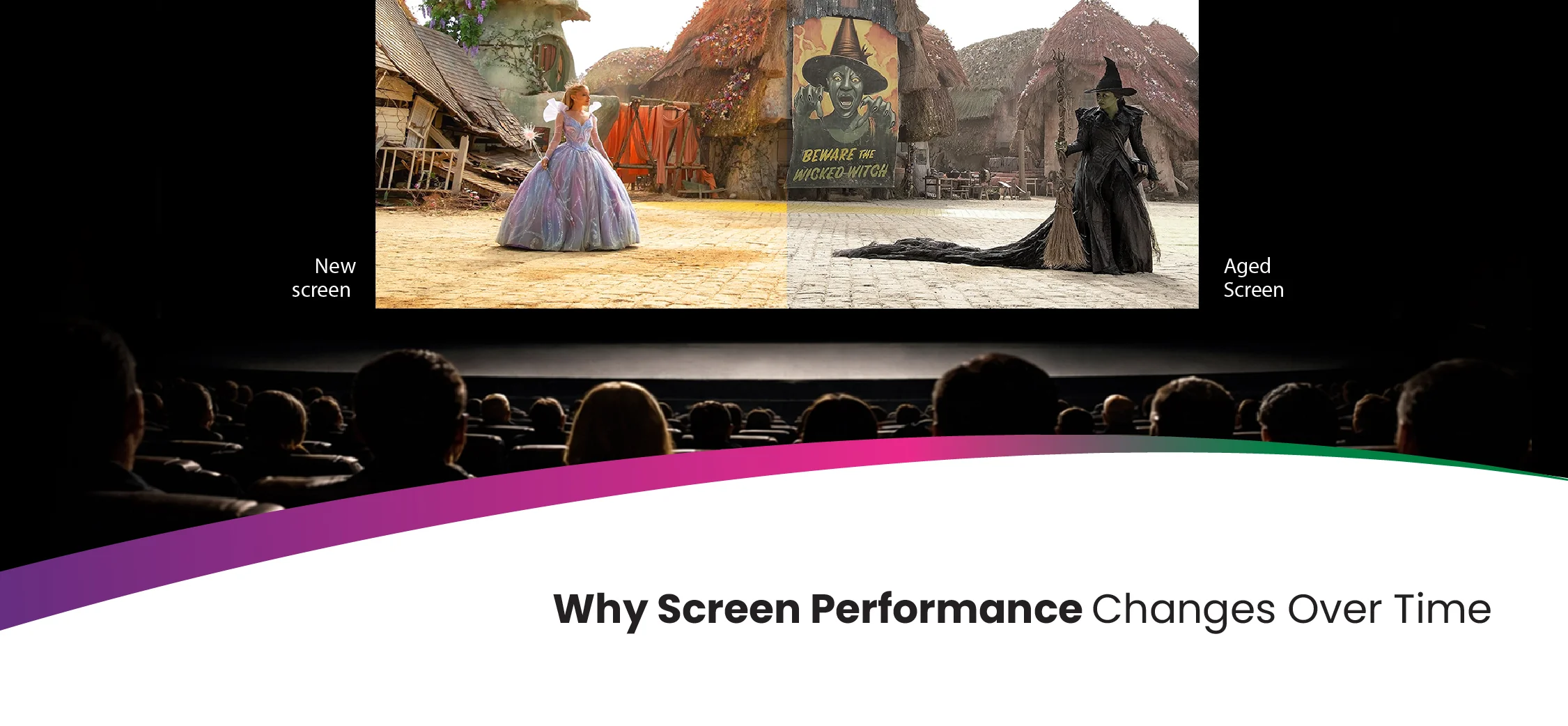
Brightness reduces incrementally.
Contrast softens over time.
Uniformity shifts subtly across the surface.
Each change is minor in isolation. Collectively, they alter the viewing experience — often without triggering a specific complaint.
By the time degradation becomes noticeable, it has usually been present for years.
Why Screens Are Taken for Granted
Cinema screens are designed to be passive. When they perform correctly, they draw no attention to themselves. The audience focuses on the film, not the surface displaying it.
This creates a false sense of permanence.
Unlike projectors, which have measurable lamp hours and maintenance cycles, screens are often assumed to be static assets. Once installed, they are expected to perform indefinitely.
In reality, screens are working components of the projection system. They interact constantly with light, heat, and environmental conditions. Over time, this interaction affects reflectivity, consistency, and image accuracy.
The challenge is not that screens fail — it is that they fail quietly.
The Real Cost of Gradual Degradation
When a screen loses performance gradually, the impact is rarely dramatic enough to force immediate action. Instead, the consequences appear indirectly:
- Films feel less immersive
- Premium formats lose differentiation
- Audience perception of image quality declines
- Operators compensate by pushing projection harder
Often, projection settings are adjusted to recover lost brightness or contrast, placing additional strain on projection equipment.
The issue is not a single failure point. It is a slow erosion of presentation quality.
And because there is no clear “before and after” moment, the screen itself is rarely identified as the source.
Why Screen Performance Matters More Today
Modern projection systems — especially laser-based systems — deliver highly stable, consistent light output. Their performance depends not only on the projector, but on how efficiently the screen reflects and distributes that light.
As projection technology has advanced, tolerance for screen inconsistency has reduced.
A screen that was adequate a decade ago may not fully support today’s brightness levels, contrast expectations, or presentation standards.
This makes screen engineering increasingly important — not as an upgrade for novelty, but as a requirement for accuracy and consistency.
Lensray and Controlled Light Distribution
Lensray technology was developed to address a practical issue observed in real cinema environments: uneven light distribution across large screens.
Rather than allowing projected light to concentrate excessively at the centre or fall off toward the edges, Lensray focuses on maintaining more consistent brightness across the screen surface.
For cinema operators, this results in:
- Improved uniformity across large-format screens
- Reduced visual imbalance between centre and edges
- More consistent image quality across seating positions
These improvements are subtle, but cumulative. They support a presentation that feels balanced and stable throughout the auditorium.
Galalite Screens: Built for Longevity, Not First Impressions
Galalite’s approach to screen manufacturing has been shaped by long-term use rather than short-term visual impact.
The emphasis has consistently been on:
- Material stability
- Consistent light handling over time
- Compatibility with evolving projection technologies
This approach recognises that cinema screens are expected to perform reliably for many years, often across multiple technology upgrades.
A well-engineered screen should not become a limiting factor as the rest of the cinema evolves.
Reframing the Screen Investment
The question is not whether screens should receive more budget.
The question is whether they should be treated as infrastructure rather than accessories.
Screens do not define the cinema experience on their own. But they influence every visual element of it, every day, for every show.
Investing in a screen that maintains consistent performance over time helps preserve presentation quality and reduces the need for corrective adjustments elsewhere in the system.
Conclusion: Legacy Built on Continuous Innovation
Cinema technology does not stand still. Projection systems evolve, audience expectations rise, and presentation standards continue to change. Screens that are treated as static assets inevitably become limiting factors over time.
Galalite’s approach has always recognised this reality.
With a legacy rooted in cinema screen manufacturing, Galalite has focused on building screens that are engineered to perform consistently over long operational lifespans. That legacy is not defined by age alone, but by continuous investment in research, testing, and material development.
Innovation at Galalite has never been about novelty. It has been about addressing real, observed challenges faced by cinema operators — from maintaining uniform image performance on large screens to supporting newer projection technologies as they emerge.
Technologies such as Lensray are outcomes of this approach: practical developments shaped by R&D and field experience, aimed at improving consistency and reliability in real-world cinema environments.
This balance between experience and ongoing innovation is what allows Galalite screens to remain relevant as cinema technology advances.
The screen may remain the most invisible investment in a cinema.
But when it is built on legacy, engineering discipline, and sustained innovation, it quietly protects the integrity of the cinematic experience for years to come.
Related articles